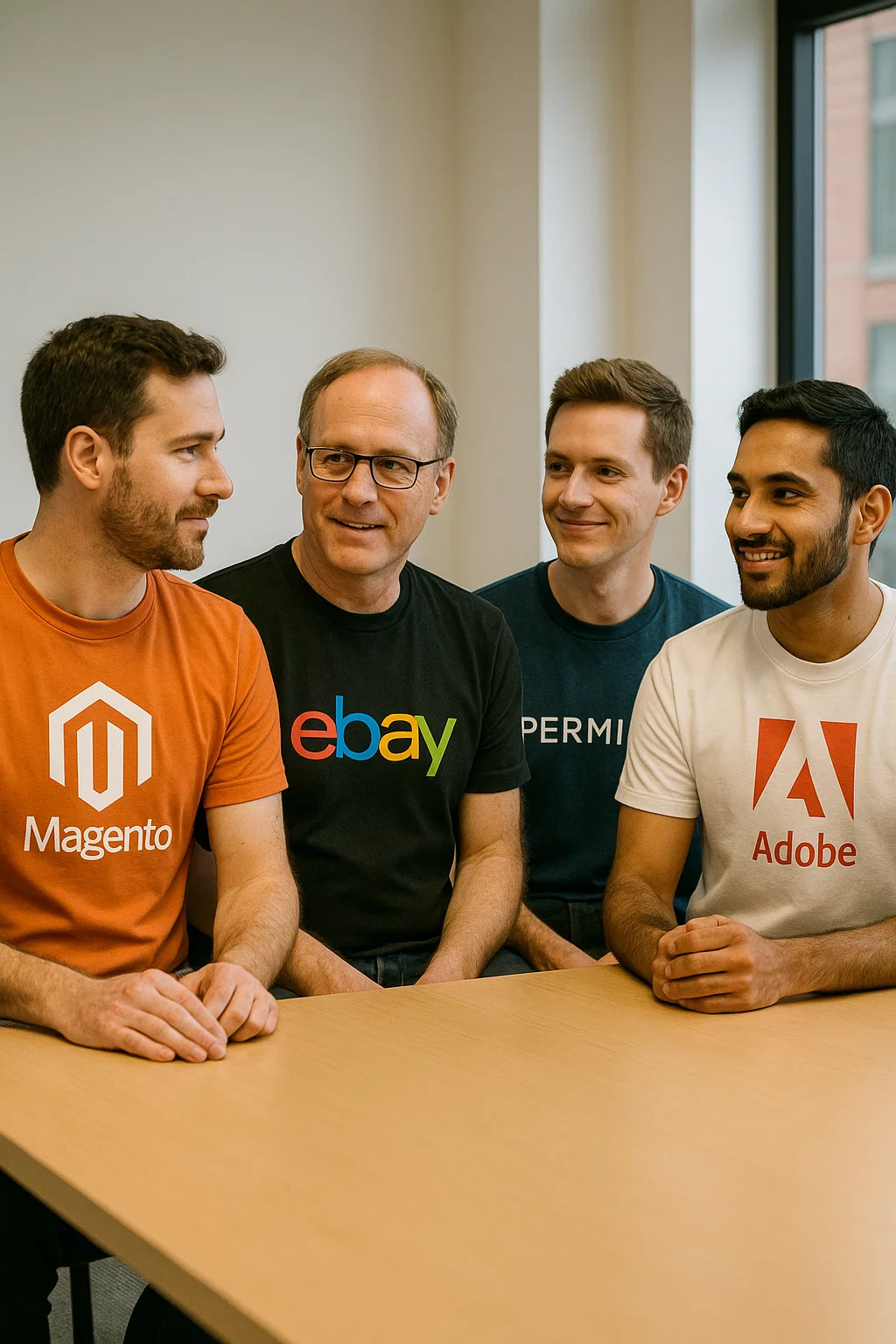
The Platform That Survived Three Owners: The Journey from Open Source eCommerce to Corporate Giant
When I first started working with eCommerce back around 2010, everyone was talking about a platform that was changing the game. It wasn’t the prettiest, nor the easiest to use – far from it! – but it offered something no other platform had at the time: almost complete freedom to do whatever you wanted.
I’m talking, of course, about the platform that began as Magento and is now known as Adobe Commerce. A story that, like any good tech tale, has its heroes, villains, plot twists, and even an open-ended finale.
The Open Source Rebels (2007-2010)
In 2007, the eCommerce platform landscape looked quite different. osCommerce dominated the open-source space, but it was getting outdated and rigid. It was in this context that Roy Rubin and Yoav Kutner, two forward-thinking developers, founded Varien Inc. and released the beta version of a platform called Magento.
The name, derived from the color magenta, symbolized the blend of red (passion) and blue (stability) – a nice metaphor, but one that perhaps didn’t fully capture the creative chaos the platform would bring to the market.
When the first public version launched in March 2008, the response was immediate. Developers and merchants rushed to try this new option that promised unprecedented flexibility. Within a year, it had already been downloaded over 500,000 times – a staggering number for a newborn platform.
What made Magento different? Its architecture. Built on Zend Framework and using PHP, it offered a level of customization that competitors couldn’t match. The use of the MVC (Model-View-Controller) pattern meant developers could modify functionality without touching core code – revolutionary at the time.
Of course, this flexibility came at a price. The learning curve was as steep as a roller coaster, and the performance… well, let’s just say “speed” wasn’t exactly Magento’s strong point in those days. But for those who needed a solution that could be molded to specific business needs, these drawbacks were an acceptable price to pay.
By 2010, the growth was undeniable. Varien rebranded as Magento Inc., and the platform had surpassed 1.5 million downloads. A mobile version was launched, positioning the platform for the mobile commerce revolution that was just beginning. The company had successfully identified and filled a crucial gap in the market, establishing itself as a serious contender in the eCommerce space.
The First Marriage: eBay and PayPal (2011-2017)
Magento’s meteoric growth didn’t go unnoticed by the big players in the eCommerce ecosystem. In February 2011, eBay made its first significant investment, acquiring 49% of the company for approximately $22.5 million. By June of the same year, they completed the acquisition, making Magento a wholly-owned subsidiary.
The acquisition made strategic sense for both companies. eBay owned PayPal at the time, and integrating PayPal more deeply with Magento created a powerful combination for merchants. For smaller businesses competing with larger retailers, this integration provided enterprise-level payment processing capabilities without the enterprise-level complexity or cost.
During this period, Magento’s product lineup expanded significantly. Magento Enterprise Edition (later renamed Magento Commerce) targeted larger businesses with advanced features and dedicated support, while Magento Community Edition (later renamed Magento Open Source) remained free for smaller merchants and developers.
But it wasn’t all roses. Many in the community feared that eBay would stifle the platform’s open-source spirit, prioritizing integrations with its own services at the expense of the flexibility that had made Magento famous. And to be fair, these fears weren’t entirely unfounded.
The platform continued to evolve technically. Developers began working on Magento 2.0, a complete rewrite that would address many of the architectural limitations of the original codebase. It was an ambitious undertaking that would take years to complete – many more years than anyone initially expected.
In 2015, the eCommerce landscape shifted again when eBay announced it would spin off PayPal as a separate company. As part of this restructuring, eBay sold Magento to Permira, a private equity firm, for an undisclosed amount. This move gave Magento independence once again, allowing it to chart its own course.
November 2015 marked a pivotal moment with the release of Magento 2.0. This wasn’t just an update – it was a complete reimagining of the platform with a modern technology stack, improved performance, and enhanced scalability. The transition wasn’t without challenges, as the significant architectural changes meant extensions and themes from Magento 1 weren’t compatible with the new version.
For many merchants, migrating from Magento 1 to Magento 2 was a logistical and financial nightmare. Imagine completely rebuilding your house because the plumbing was updated – that’s more or less how many merchants felt. The developer community was also divided, with many questioning whether the complete rewrite was really necessary.
By 2017, Magento had solidified its position as an eCommerce leader. Gartner named it a leader in Digital Commerce, and Forrester recognized it as a leader in the B2B segment. The platform also underwent a rebranding, with Magento Community Edition becoming Magento Open Source, and Magento Enterprise Edition becoming Magento Commerce.
The Second Marriage: Adobe (2018-Present)
In May 2018, Adobe announced it would acquire Magento for $1.68 billion – a testament to the platform’s value and market position. This acquisition represented more than just a business transaction; it signaled a new chapter in Magento’s evolution.
Adobe’s vision was clear: integrate Magento into its Experience Cloud to create an end-to-end platform for content creation, marketing, advertising, analytics, and commerce. For merchants already using Adobe’s suite of products, this promised a more seamless experience and deeper integration capabilities.
The acquisition brought both opportunities and challenges. On one hand, Adobe’s resources and reach opened new doors for Magento. On the other, some in the community worried about the future of the open-source version and the platform’s community-driven nature.
In the years following the acquisition, Adobe continued to develop and enhance the platform. In 2019, they introduced Adobe Commerce Cloud, combining Magento Commerce with Adobe’s analytics, personalization, and marketing tools. They also launched Progressive Web App (PWA) Studio, enabling merchants to create app-like experiences for mobile users.
2020 marked the end of an era with the official end-of-life for Magento 1. After 12 years of service, Adobe discontinued support for the original version, encouraging merchants to migrate to Magento 2 – now officially called Adobe Commerce for the paid version. This transition was significant, as many businesses had built their operations on Magento 1 and faced complex migration projects.
Adobe also embraced AI and machine learning, introducing AI-powered product recommendations and other intelligent features. These capabilities, powered by Adobe Sensei, helped merchants deliver more personalized shopping experiences.
Today, Adobe Commerce (formerly Magento Commerce) continues to serve as a powerful solution for mid-market and enterprise businesses, while Magento Open Source remains available for smaller merchants and developers – though many question for how long, given Adobe’s clear focus on the commercial version.
The uncomfortable truth is that, under Adobe, the platform has lost some of its original identity. What was once a flexible, accessible solution for businesses of all sizes has become increasingly corporate, with pricing that often puts Adobe Commerce out of reach for small and medium-sized businesses. Complexity has also increased, with integration into the Adobe ecosystem adding layers of functionality that not all merchants need or want.

The Community Response: Forks and Alternatives
One of Magento’s greatest strengths has always been its community. When Adobe’s acquisition raised questions about the future of the open-source version, the community responded in a way that demonstrates the platform’s enduring impact.
Mage-OS emerged as a community-driven fork of Magento Open Source, aiming to ensure the platform’s open-source future regardless of corporate decisions. Led by respected community members, Mage-OS has gained significant traction, with regular releases and growing adoption.
Another notable development has been the rise of Hyvä, a frontend alternative for Magento 2. Created by Willem Wigman, Hyvä addresses one of Magento 2’s most criticized aspects – its complex frontend architecture. By replacing Magento’s default frontend with a simpler, more performant alternative, Hyvä has revolutionized development for Adobe Commerce.
The numbers speak for themselves: as of early 2025, Hyvä powers over 5,000 stores worldwide and has seen 100% year-over-year growth. It’s used in 81 countries and has a thriving community with over 5,500 members in its Slack channel and 8,000+ partner developers.
Hyvä has expanded beyond its original scope, introducing Hyvä Checkout, Hyvä Enterprise for Adobe Commerce compatibility, and most recently, Hyvä Commerce – a suite of tools that enhance Adobe Commerce’s admin experience and content management capabilities.
These community initiatives demonstrate something remarkable about the Magento/Adobe Commerce ecosystem: its impact extends beyond the code or the company that owns it. It has created an ecosystem of businesses, developers, and solutions that continue to innovate independently.
It’s almost as if the community is saying: “If you won’t maintain the original spirit of the platform, we will.” And honestly, this community response might be the platform’s most important legacy.
The Future: What’s Next?
Looking to the future, several trends are shaping the evolution of Adobe Commerce and the ecosystem around it:
First, the balance between Adobe Commerce and community-driven alternatives like Mage-OS will continue to define the ecosystem. Adobe is focusing on enterprise features and integration with its broader product suite, while the community is ensuring that open-source innovation continues.
Second, frontend technologies like Hyvä are transforming how Adobe Commerce stores are built and experienced. The focus on performance, developer experience, and modern technologies is making the platform more competitive in a landscape where speed and user experience are paramount.
Third, content management is becoming increasingly important. Hyvä’s roadmap includes a completely reimagined CMS, addressing one of Magento/Adobe Commerce’s traditional weaknesses. This focus on content reflects the broader trend of commerce and content convergence.
Fourth, AI and personalization will play a larger role. Adobe’s investment in AI through Adobe Sensei is bringing intelligent features to Adobe Commerce, from product recommendations to automated image optimization.
Finally, the community’s role remains crucial. Events like Hyvä Developers Paradise and the Mage-OS General Assembly demonstrate the vitality of the community and its commitment to the platform’s future.
Lessons from the Journey

Having worked with Magento/Adobe Commerce across different roles and companies, I’ve witnessed firsthand how it transformed from a flexible alternative for small businesses to a comprehensive enterprise solution. This journey offers several lessons for both technology platforms and businesses:
- Community matters. Magento’s success has always been tied to its community of developers, merchants, and partners. Even as ownership changed, this community has remained a driving force for innovation.
- Balance flexibility with usability. Early versions of Magento offered tremendous flexibility but often at the cost of complexity. The platform’s evolution has been about finding the right balance – maintaining flexibility while improving usability.
- Adapt to changing market needs. Magento/Adobe Commerce has continuously evolved to address emerging trends, from mobile commerce to headless architectures to AI-driven personalization.
- Ownership changes impact ecosystems. Each acquisition – from eBay to Permira to Adobe – has shaped Magento’s direction. These transitions highlight how corporate decisions influence technology ecosystems, not always for the better.
- Open source creates resilience. The open-source nature of Magento has allowed the community to ensure its continuity through initiatives like Mage-OS, even as corporate strategies shifted.
The story of Magento/Adobe Commerce isn’t just about technology – it’s about how a platform can create an ecosystem that transcends its original creators. From its humble beginnings as an osCommerce alternative to its current position as part of Adobe’s experience platform, it has demonstrated remarkable resilience and adaptability.
As eCommerce continues to evolve, the combination of Adobe Commerce’s enterprise capabilities, open-source foundations, and vibrant community positions it to remain relevant for years to come. Whether you’re running a small online store or managing digital commerce for a global enterprise, the journey from Magento to Adobe Commerce offers valuable insights into the past, present, and future of eCommerce.
And personally? I miss the wild days of the original Magento, when everything seemed possible (even if it took three times longer than expected to implement). But I also appreciate the maturity and stability the platform has gained over the years. As with any good coming-of-age story, something is lost and something is gained. The trick is making sure what’s gained is worth more than what’s lost – and the jury is still out on whether that’s the case with Adobe Commerce.

